Thursday, June 1, 2023

Last blog! 😎


Hi guys 🤩 Welcome to the last blog 🥹♥️

I am very happy that you followed with me during this time, because we have learned a lot of things together, and I am happy to be able to teach you from what I learned in my Didactics in English 1 classes.

This last blog the whole class participated in doing an exercise or activity for all or some of the class to develop, as an after class activity, by the way this time the teacher assigned us the topic and gave examples of activities we could do.

You remember my exposure group, don't you? 👀 Well, with my group we had to do some activity about Reading comprehension 🤯 well we gave the introduction explaining what it was about, warm up, about reading, comprehension, tips, exercise and wrap up; we had approximately 20 minutes to do the activity, my group and I chose an article where in pairs they would have to read it, then they would find words in a word search then they would have to answer some true and false questions, at the time to answer they did not have the page with the document because that was the point that they would answer according to what they had understood. 🤔🤔

And so went the other groups, doing the activities, some only did them in groups of 4 or 5 people, or the whole class, here are some pictures I could take. 🤗

This is my group 🤗


Happy vacations guys, I look forward to seeing you next cycle 🤩🤩.


Friday, May 26, 2023

Teaching receptive skills

 Hello guys, we almost finished the registration, thanks for continuing to read me, and learning together. 🤩

The topic is respective skills.

- Receptive skills, we refer to the ability to have an understanding of what is spoken and written, that is, it is important that students can interact with each other to have good effective communication with others. The best way to teach this skill is to create a space or environment in a creative and authentic way and that the activities have a lot of interaction.

- Oral comprehension is an essential skill for a very effective comprehension, the materials that we can use are podcasts, songs and videos. For this we will use activities such as debates, listening comprehension exercises, it will be a way to create more confidence in the students.

- Reading comprehension is another important receptive skill, we must use a material appropriate to the student's study level, that is, if they are students of advanced degrees we can use the newspaper, articles and some topic of interest to them, if we work with small grades We can use stories, fables or themes for children, among the activities we can let them make a summary, or essay.

- Differentiated teaching is an important approach to teaching receptive skills, that is, being able to adapt and create a good method for student learning to make it easier for them, adapt to the needs of students, this will help Allow students to perform their skills at their own pace.

- The evaluation of receptive skills is important, it determines the progress of the students and sees in which area it can be improved and the extra tasks are applied, for example solving questionnaires, tests after classes. Let students know their performance and help them improve.

Let's remember that comprehension texts are easy if they are short, if there are speakers who understand what they read, also if they speak naturally even if the subject is interesting for them, comprehension will be much easier.

The objective of the skills is to help students so that they can communicate effectively and their learning is permanent.

Teaching speaking

 Hi guys 🤩 hope you had a great week, we continue with our blog, this day we will learn about teaching speaking. 🗣

We will start with the Dimensions of speaking which we have.

1. Transactional or Interpersonal

2. Interactive or non-interactive

3. Planned or Unplanned

Now we have some conversation strategies.

Conversation rules and structures, Zoltan Dörnyei and Sarah Thurrell add more discourse categories such as starting conversations, (How are you? What a nice dog! Finally some sunshine!), Interrupting (Sorry to interrupt, but...), changing the subject ( Oh, by the way, that reminds me...) and closings (It's been nice talking to you...) (Dörnyei and Sarah Thurrell). Well, I don't want to keep you from your work... we should meet sometime) (Dörnyei and Thurrell 1994: 42-43).

Survival and repair strategies, learners should be able to ask for repetition by using formulaic expressions, repeating to the point of conversation breakdown, we can add the ability to be able to paraphrase i.e. to be able to ask about a word you don't know using another type of word without implying that you don't know it.

Real talk, when having a conversation with proficient English speakers must know that the conversation goes beyond the questions in the books, Helen Basturkmen examined the transcripts of the conversations of master students and found that they used, among other things, rephrasing questions.

Functional language, adjacency pairs and fixed phrases

A lot of speaking is made of up of fixed phrases or lexical chunks, such as Catch you later, Back in a sec, Can I call you back in a couple of minutes?.

Fixed and semi-fixed phrases crop up a lot in functional exchanges. Thus, for example, we can offer people things, such as a drink, a coffee, etc., by saying D'you fancy a ...? Would you like a ...? Shall I get you a...?

Many functional exchanges work well because they follow a set pattern. One such pattern is the adjacency pair (Cook 1989: 53-57). If someone approaches you and says Nice day isn't it? they expect a paired response, such as Yes, isn't it. If we say D'you fancy a coffee? the adjacency pair is either Yes, please or No, thank you.

When teaching speaking, we need to make students aware of fixed phrases, functional sequences and adjacency pairs. We can do this by teaching functional exchanges. We can have students look at transcripts of typical exchanges and we can let them watch film clips of this kind of language use.

The roles of the teacher in a Speaking Lesson

·      Prompter

·      Participant

·      Feedback Provider 

Sunday, May 21, 2023

Teaching writing

 Hi guys, this day we will learn the techniques of writing, we start with a simple practice that maybe in school we practice calligraphy, for example.


I also learned to write in handwriting and letter writing. It was very easy but I think it is good to learn to have more ease in the fingers to be able to write nicely and of course practice. There is still time to buy a calligraphy book guys. 😜

What do we mean by writing skills? 

Writing envolves many different aspects. It is useful to look at them under these headings.

  1. Handwriting 
  2. Spelling
  3. Punctuation
  4. Sentence construction (Depends on language)
  5. Organizing a text and paragraphing
  6. Text cohesion
  7. Register style 

We did a crazy story as a group, where we had a certain amount of time to pass the notebook to the partner next to us, the story was all weird but we had fun when we read the final story, as well as listening to another group's story.


If you remember that we saw this process in another subject, it is easy guys, just follow the steps to obtain a composition of any topic we want to write.


It was really nice to know that before as a form of thanks if you stayed overnight in a hotel or family, they thanked you with a note, I wish it had not gone out of fashion, besides being a good detail, generates the writing through a process because it leads to who is addressed, the context, and an end.


I hope you guys liked it, I'll come back and give you more examples of this topic.

Thanks for reading. 

Monday, May 15, 2023

Body language & coordination, and improvisation.

Hi guys, welcome to a new blog! 🤩🤩🤩

These are really coming in handy as we expose ourselves to certain physical activities.

*Keeping focus.

- Form a line and maintain seriousness with the partner in front of you, i.e. for nothing you would have to laugh or avert your gaze because you would lose focus. 🫠

- Also another way was to make a serious between the partners who was in front only eye contact to see who lost sight of the target of the exercise. 🙄

- The other exercise was with your eyesight to see a partner, like a Burger King ad "I've got you in my sights boy" but it would no longer be online but moving around the room without missing who you decided to see, putting into practice with your concentration. 🥴

*Expressing emotions with your face and body.

- We started by making a line in front of us we would have our partner, they would try to make us laugh in any way with the condition is that it would only be easy expressions the partner in front of us would have to keep their easy expression would be while the other would try to make them laugh. 😝

- We changed places and the activity was to walk like models hehe 🤭 many of us were embarrassed because it is not the same to do it in front of the mirror to be in front of many people, but also keep walking expressing happiness, anger, sadness to see any partner we had in front of us, I remember they said they were angry faces, not like that as I dislike you. 😰😂 In the same way we kept walking and we would say something that we liked about the classmate that we crossed our eyes, for example I like your blouse, your glasses or earrings. 🫶 Being good vibes. 😎

*Improvisation. 

- This part was too much fun because the previous class was pending to take a scene from a movie to improvise it in the classroom, for example the group where I was had a scene from Sherk and we exchanged scenes with the other groups, we also exchanged a background sound it was very nice to represent the ideas according to the background sound. 🥸

NOTE: I promise to upload a video of the imitations, right now I'm having trouble uploading it 😣


Monday, May 8, 2023

Voice projection & body languaje


Hi guys, welcome to my blog, today we are going to learn about voice projection and body language.
we are going to practice imitations. for example: 

                                                        woman ← Imitation → man.

                                                                                  ↓

                                                                                child


We can also imitate a:             Teachers

                                                Friends

                                                Famous person

We worked a lot on breathing, we started a conversation, but little by little we were moving further and further away to such an extent that the interference of the other conversations we did not understand what we were saying because we had to have a great concentration regardless of the environment, then we continued with the conversation but using a pencil in the mouth and we took distance because it was even more complicated because we could not open our mouths wide, we measured our level of concentration trying to make the partner in front of us laugh, which for some was more difficult, for others it was so easy to lose concentration, finally we did the exercise as a warm up to start the gym routine, it is clear that we would be agitated and we would have problems to express ourselves well since we were playing with the air, so these exercises help us to have a better concentration, a good breathing and a better way to express ourselves regardless of the environment.


We also had the intervention of Nidia, she explained a little about the three basic intentions of the locution, ie. 

Institutional intention, it would be in a serious and paused way, for example when giving a news, it is included in this intention.

Sales Intention, it is considered commercial, since the message must be in an enthusiastic way, like creating a need to the listeners in a subtle way, example of this are the announcements of Claro, Movistar and even food ads. 

Natural Intention, that is to say in a neutral tone since it looks for a neutral connection, that the way of reading is more like telling it.

It was really interesting and fun to be able to do this kind of exercises because it helps us to have more confidence in us and if we want to be the voice of any advertisement we can take it as a hobby and the most important thing was that this will help us in the future either as a teacher to be able to express ourselves well.


Wednesday, May 3, 2023

Describing teachers

Hi guys, we are starting the third and last registration, this topic is very nice because we can describig teachers but not in a physical way but in a professional way inside and outside the classroom.

  • Teacher's role in the classroom.

Leading from the front of the class, she always reminds students of homework or something particular to a topic, interacts for the class through discussion, helps students when they forget a meaning, and gives feedback on a large project.

  • The teacher as an organizer.
The teachers always plan their classes before, during and after they develop them, they practically receive the class themselves and try to make it as easy as possible for the students to understand it.

Engage → instruct (demostrative) → iniciative → organise feedback

  • Teachers as performers.
Teachers act depending on the activity being done with the students, for example:


  • Rapport
This refers to the relationship that students have with teachers and vice versa, i.e. students like teachers to differentiate them from their name, their personalities, and preferences and especially for their qualities that make them unique, that they are listened to, they like teachers to be empathetic when calling their attention and correcting them, in some cases teachers tend to take more affection for some students than others, this does not leave aside that teachers treat students in general in the same way, as this speaks well professionally.
  • The teacher as a teaching aid.
Having access to many resources is good for teachers, but it goes beyond that. Teachers simply transmit much more from their expressions, body language and pronunciation.

For example, you can't talk about a topic where he has to do physical activity and the teacher just says jump and he is sitting down, or even do a dialogue where he represents a happy person and he is serious, so that's why expressions and body language is very important when it comes to developing a topic.
  • Native-speacker vs Non-native-speacker teachers.
Many times as non-native teachers they are subjected to injustices in other words native teachers tend to feel superior however non-native teachers have struggled to prove their credibility that they are on the same page as native teachers.

However, it is admirable the role that a non-native teacher plays in these times since he knows what his student is feeling in his moment of learning a foreign language and this will readjust the teacher's performance when necessary. 

On the other hand the native teacher can enrich the students with his anecdotes, an example of this is "Thanksgiving in the USA", he shares about his culture and linguistic safety.

My kids, I hope you liked it as much as I did, soon the next blog will be very funny and entertaining.

Wednesday, April 19, 2023

Describing learners


Hi guys, this is the last blog of the log, I hope you have learned as much as I have.

Describing learners.

They have a need for individual attention and approval from the teacher. They generally display an enthusiasm for learning and a curiosity about the world around them. They find abstract concepts such as grammar rules difficult to grasp.

We shild consider the following aspects:

  • AGE
  • LEARNER DIFFERENCES
  • LANGUAGE LEVELS
  • THEIR MOTIVATION
  • BACKGROUND*
Children ages 9 to 10 learn differently from older children, adolescents and adults in the following ways:

They respond to meaning even if they do not understand the correct words, they also learn indirectly, by seeing, hearing and touching is a very fast way of learning as it helps them to interact since they do not understand grammatical concepts, in a short time they lose interest about a subject.

Adolescents are considered problem students, they show interest whenever they find a subject interesting and they perform successfully, at this stage it is good to have a good relationship with their teacher, as students are looking for social approval, depending on the trust that is generated between student and teacher can talk about experiences or family issues.

Adults have a better behavior since, due to their maturity, they tend to draw on a series of life experiences, have high expectations in their learning since they want to have a good academic formation.


That day we had a talk on how to create the right CV.


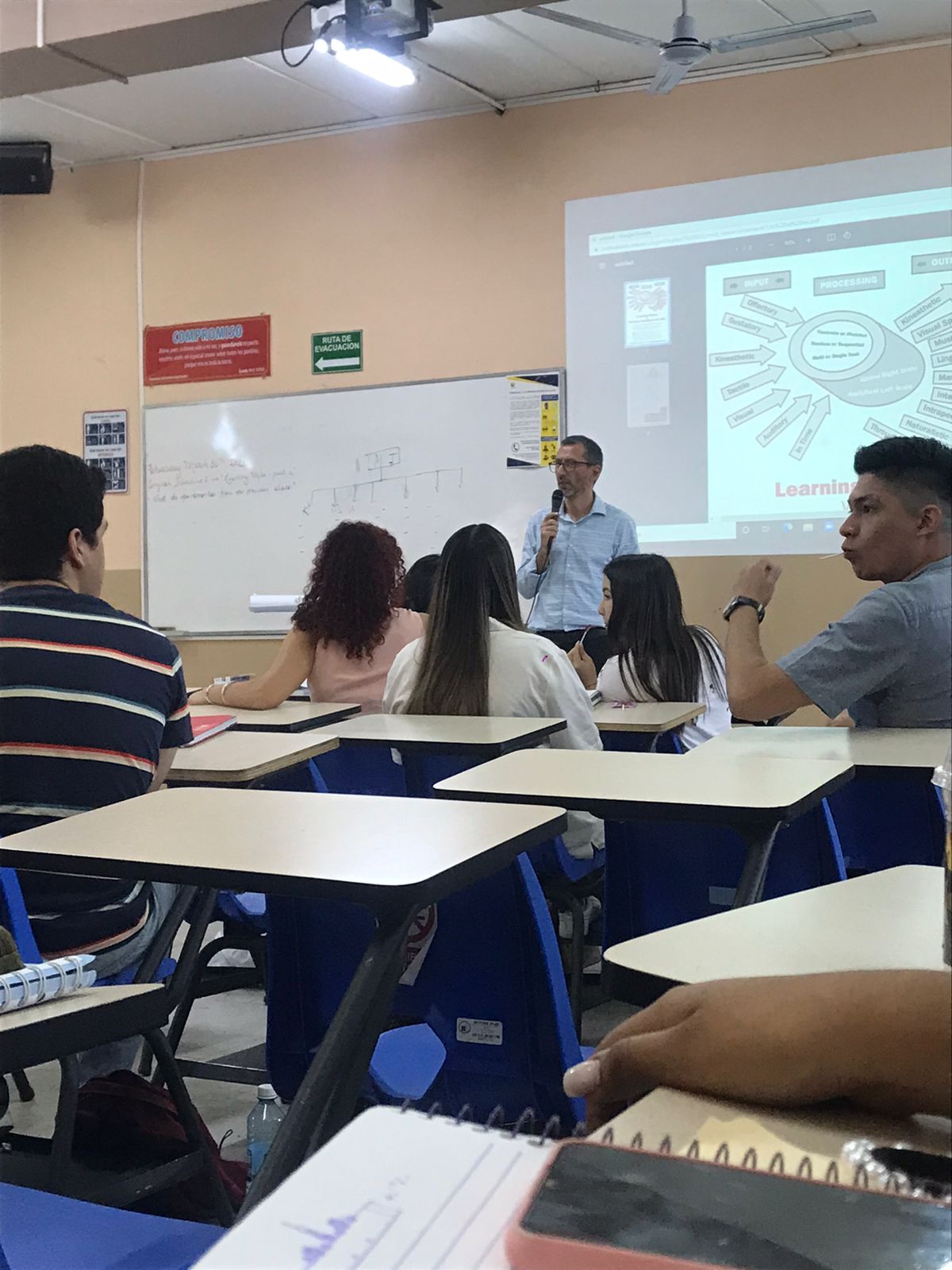
Learning styles

 Hello, I hope you had a good vacation, tell me did you go to the beach, or where did you go?

Back to our blog, this is the turn of learning styles.

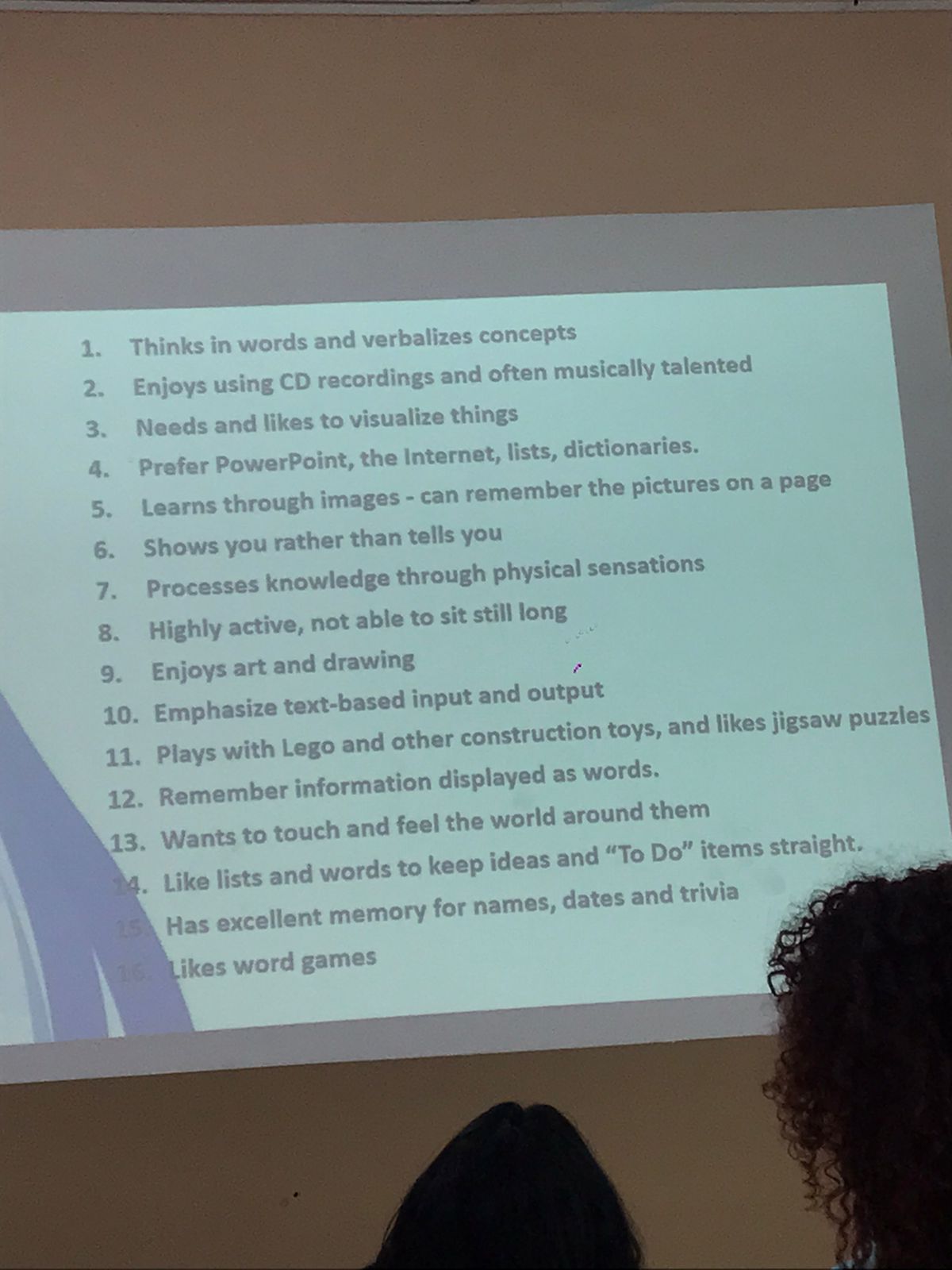
Note: 100%of population uses a combination of all three styles listed above. Most often one type is dominant.

One of the most accepted understandings of learning styles is that student learning styles fall into three categories: Visual Learners, Auditory Learners and Kinesthetic Learners. These learning styles are found within educational theorist Neil Fleming’s VARK model of Student Learning.

  • Students’ preferred learning modes have significant influence on their behavior and learning.
  • Students’ preferred learning modes should be matched with appropriate learning strategies.
  • Information that is accessed through students’ use of their modality preferences shows an increase in their levels of comprehension, motivation, and metacognition.
  • Visual learners prefer the use of images, maps, and graphic organizers to access and understand new information.
  • Auditory learners best understand new content through listening and speaking in situations such as lectures and group discussions. Aural learners use repetition as a study technique and benefit from the use of mnemonic devices.
  • Read & Write, Students with a strong reading/writing preference learn best through words. These students may present themselves as copious note takers or avid readers, and are able to translate abstract concepts into words and essays.
  • KinestheticStudents who are kinesthetic learners best understand information through tactile representations of information. These students are hands-on learners and learn best through figuring things out by hand (i.e. understanding how a clock works by putting one together).


Classroom practice.


Bustillo's intervention for group change!!!


Saturday, April 8, 2023

Expo 3

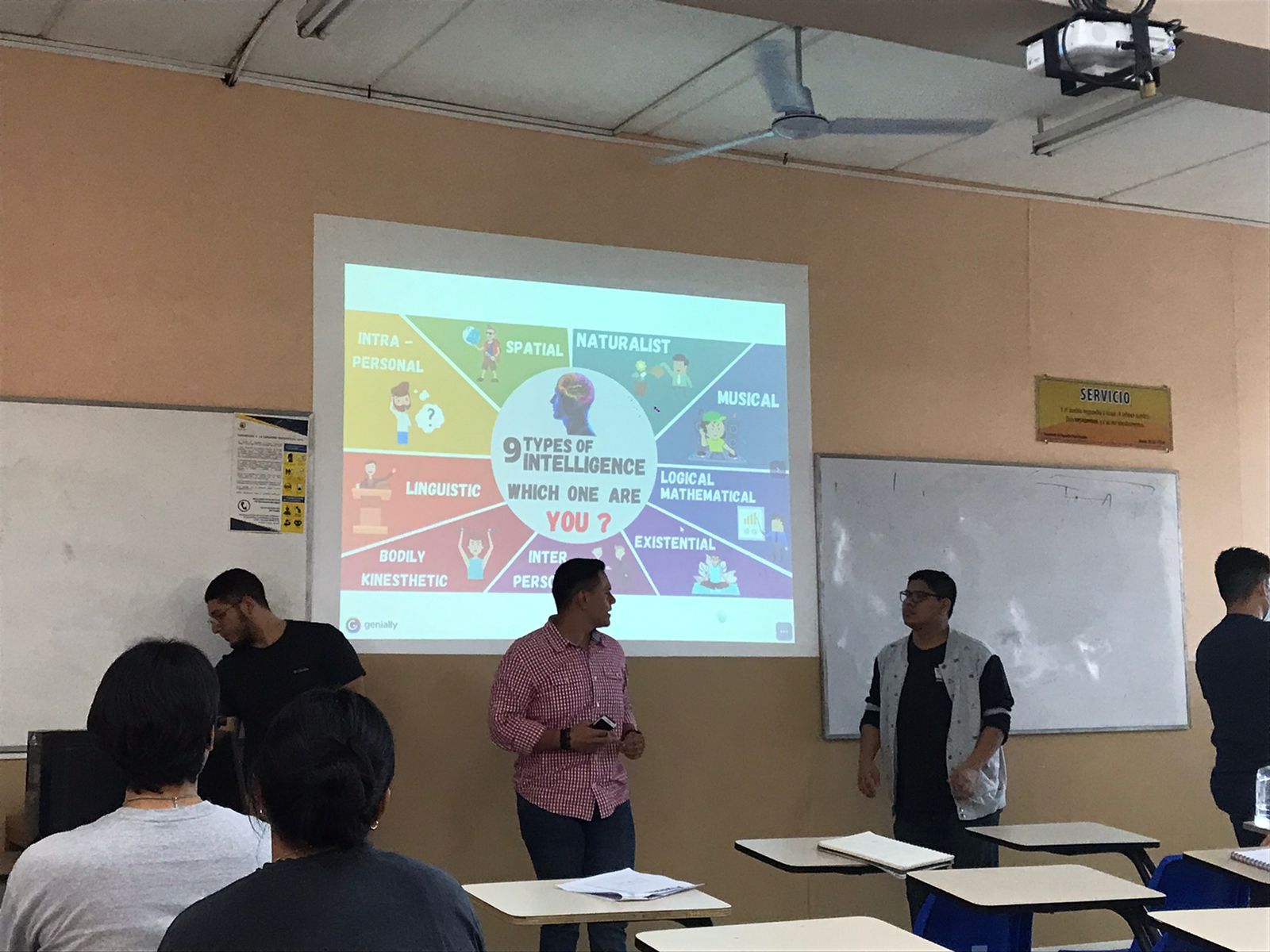
 INTRAPERSONAL INTELLIGENCE

is the ability to understand one's self including their thoughts, fears, and motivations, and the ability to then utilize this understanding to make decisions and communicate.

Examples of intrapersonal skills include attributes such as planfulness, self-discipline, delay of gratification, the ability to deal with and overcome distractions, and the ability to adjust one's strategy or approach as needed.


NATURALIST INTELLIGENCE

is the ability to identify, classify and manipulate elements of the environment, objects, animals or plants.

Naturalist intelligence can be stimulated in the classroom through activities. Some examples are the creation of habitats, caring for animals and plants, collecting, and classifying natural objects and organisms such as rocks, insects, or snails.

Characteristics of people with developed naturalistic intelligence:

Caring for gardens and love plants.

They have plants and love to take care of them. They take care of them and are always aware that they do not lack anything.

Enjoy outdoor activities like camping and hiking.

They love to visit farms, fields, and outdoor settings. Camping and hiking are part of their routine activities or entertainment.

Volunteering for ecological organizations to preserve the environment.

They are part of organizations that are consistent with their ecological beliefs. They participate in activities, marches, and struggles to preserve and care for the environment.

Have more than one pet (not just dogs and cats).

They take care of pets such as birds, sheep, cows, rodents, etc. They enjoy having animals around and interacting with them.

They enjoy watching programs related to nature the behavior of animals and plants. They watch series related to climate change and subscribe to channels that deal with environmental issues.

EXISTENCIAL INTELLIGENCE

which is one of the types of intelligence from Gardner’s theory, is the intelligence of big picture thinking. Precisely, the existential intelligence definition is the “capacity or ability of an individual to understand and contemplate philosophical topics relating to mankind’s existence.”

The biggest characteristic of kids with high existential intelligence comes from their ability to see the big picture. These kids have a great understanding of seeing the world as a whole. So they go beyond the physical senses to explain themselves and understand the world around them.

Kids with existential intelligence characteristics might be great team leaders as they are good at giving advice. In addition to that, they might enjoy looking at things from different points of view.

Let’s explain these kids’ characteristics with some examples from their daily routines:

  • These kids enjoy writing journals and communicating with others about how they spend their time.
  • They like to help people or animals and are eager to participate in charity activities.
  • They easily communicate with their peers and enjoy discussing intangible things.

TRY TO ANSWER THIS QUESTION GUYS... 

HERE ARE THE EXPOSITIONS, I TRIED TO BE AS CLEAR AND PRECISE AS POSSIBLE FOR YOU TO HAVE A BETTER UNDERSTANDING, IN ADVANCE AN APOLOGY FOR THE DELAY, BUT I HAD TECHNICAL PROBLEMS THAT I START TO RESTORE. 

SEE YOU SOON GUYS.


Last blog! 😎

Hi guys 🤩 Welcome to the last blog 🥹♥️ I am very happy that you followed with me during this time, because we have learned a lot of things...